Saturday, May 03, 2008

Gwendolyn Meier on autism

(Notes from April NSSLHA meeting)

Gwendolyn Meier works at Villa Esperanza, which mostly serves children with severe communication disorders (often autism), aged 2-22. Many children come to them because they can’t be managed in their own school district. They have a Speech-Language center adjacent to the school. It’s a very specialized place, because they see very few stuttering or voice disorders, or even articulation unless it is a verbal apraxia in conjunction with autism.

Autism is a behaviorally-defined disorder. There is no medical battery given to confirm it; it is characterized by behavioral symptoms. It was first talked about in 1943. The incidence estimates have significantly increased from 1 in 10,000 in 1980 to 1 in 100 today.

Key aspects of an autism diagnosis:

1) Limited social interaction—including eye contact, response to communication, initiation of interaction (e.g. peek-a-boo)

2) Communication—verbal communication may be disordered, with words used unusually and, the developmental progression won’t be ordered typically. For example, the first words might be requests instead of comments (unlike typically-developing children).

3) Restrictive, repetitive, stereotyped behavior—including self-stimulation. We think this might be due to sensory stimulation, although it may serve some sort of purpose (we don’t know much about this).

Symptoms may appear to different degrees and affect different areas of functioning. There is reduced connectivity shown between brain regions (association tracts); these are underdeveloped and don’t work as a whole system.

The core deficits of ASD affect many areas of function. For example, an inability to shift attention easy can result in stereotyped behaviors. Impaired use of symbols (shared meanings) especially affects abstract concepts.

There are very few standardized measures that look at the core deficits of autism. We know that standardized measures usually look at form and content, which are often disordered. However, this might not be their biggest area of need, e.g. Can they use. back-and-forth interaction with another child?

Language functions, initiation and rate of communication are very different from a typically-developing child. Requests are the easiest to teach, while commenting is much more difficult. Few resources aid us in evaluating pre-intentional, preverbal and non-verbal communication. PECS (Picture Exchange Communication System) is one example of an AAC strategy, but there is little guidance on selecting and implementing such intervention.

Other important factors:

1) Communication mode—e.g. using eyes or sounds to communicate, even if these don’t seem intentional to a casual observer

2) Rate—we need to look at rate of initiation vs. response. Do we need to ask questions differently in order to get a response?

3) Communicative functions—do they comment/show/share at all? These may be absent, especially for younger children

a. Request

i. Object/activity

ii. Information

b. Response

c. Comment

d. Express feelings

e. Prosocial statement

f. Conversational skill

4) Non-verbal communication—eye gaze and facial expression for social regulation, regulating interaction, gaining info—e.g. looking at someone for a request to spin around

5) Social communication—the most basic is back-and-forth between mom and baby’s smiles, up to more abstract, such as appropriate ways to interrupt mom when she’s on the phone. A high-functioning intervention are “social inferencing” questions. Register-switching is also under this category.

6) Language content and form—although the more foundational skills are basic turn-taking and conversational abilities that enable them to make friends and have interaction!

Aided language stimulation/visually cued instruction—gives visual cues along with oral language input, building off their visual sense and using an intransient form of communication.

Assessment:

  1. Context- have natural communication exchanges (Wetherby et al. 1997)
  2. Who the individual is interacting with
  3. What cueing is helpful; including what parents are doing
  4. Motivation to communicate
  5. Hidden abilities or inroads—where can these kids function? Some grow up and write that actually, they understood much more than we realized. Non-verbal children may learn how to type or use visual forms of communication.
  6. Multiple sources of information, such as interviews with parents or teachers, observations of everyday situations.

Treatment

1. Functional communication (basic wants and needs)—including understanding of cause and effect, reducing learned helplessness by reinforcing any type of communication. For the adult, these skills might include toileting skills, identification of feelings, school readliness, yes/no responses, labeling. However for the child, these are most likely to be foods, toys and activities at the very beginning.

2. Initiation and Motivation

Motivation drives communication—first teach cause and effect, then expand communicative functions. Increasing functional equivalents to challenging behavior have been shown to reduce such problems. Find out what is reinforcing and personally meaningful to the child.

3. Language development

Language is learned in interaction with others. Competence is much more than vocabulary and sentence structure; we want to teach warm communicative interactions. Pragmatic functions make children stand out vs. blending in- much more dramatically than proper grammar or complete sentences. Interaction skills may be more important to real-world functioning than other language skills.

4. Plan for and practice generalization from the very start.

Online resources:

Indiana Resource Center for Autism

http://www.iidc.indiana.edu/irca/IRCAarticles/fcommunicationarticles.html

Susan Stokes Autism Articles and IEP goals

http://www.specialed.us/autism/index2.htm

Autism Inspiration Sensory Ideas

http://www.autisminspiration.com/public/department44.cfm

WIRED magazine article

http://www.wired.com/medtech/health/magazine/16-03/ff_autism

Thursday, April 03, 2008

Ask Abby (or Cari/Ed/Nancy, etc.)

Have a question you've always wanted to ask any/all of the professors, but didn't have the guts (or time) to? Well, here's your chance!

There are 2 ways to submit questions:
* By leaving a "comment" thru the blog (link below)
* By sending an e-mail to csulacomd@gmail.com

ONE question will be picked and featured on the next NSSLHA newsletter. Please indicate in your message WHO you'd like to answer the question. Your identity will remain anonymous in the feature unless requested otherwise.

And by the way...
NSSLHA MEETING NEXT MONDAY, 4/7!
Don't miss out on a great workshop on treatment tips for kids with Autism (by our very own, Gwendolyn Meier).

Thursday, March 27, 2008

Autism: The Musical

Hi all!
There is a really great movie titled "Autism: The Musical" that is currently available on HBO.com.  It's available to view online for free for about a week. 


Take advantage of it! You won't regret it!


big thanks to  ms. truelashes for fwd'ing the info. =)

Monday, March 10, 2008

Sharon Hendricks- Accent Modification

(notes from NSSLHA meeting, March 3rd)

Sharon Hendricks was trained in SLP at University of Washington in Seattle. When she was a grad student, she became a TA for “American speech sounds” for international students, often doctoral students who had brilliant minds and needed competency in English to communicate with Americans. There are many similar students on our campus!

Accent modification is about breaking down these barriers to communication. The goal is not to “reduce” an accent, but increase communication/intelligibility. You can do this with an “accent”, which is an actually interesting and important part of a person. An accent tells about their heritage and their culture; we shouldn’t want to eradicate these. Modification refers to change of behavior, giving tips/tools on how to produce certain sounds or words to be more intelligible.

Sharon works now full-time at LACC, teaching classes for non-native English speakers. There’s a lot of ethnic and age diversity on that campus. There is an effect of age on second-language acquisition; it becomes more difficult because speech sound patterns become imprinted. Many of her students are older Russian women who want to get a job to support their family, but most of their social life is with Russians. Younger people might have a career path in mind.

Components of accent modification:

1) 1) Talk with client to know what/why they want to learn. Most people who do accent modification, do it one-on-one (even though she teaches a class). What do they want to communicate for? How much do they want to learn (functional intelligibility, expanded vocabulary?) Intelligibility really affects your social life because people react to you, you might withdraw from going out into the neighborhood and send your daughter to the store instead. These things lead to emotional frustration.

2) 2) After the initial interview with client: they need to hear the difference between their production and the intended production (e.g. /th/ vs /z/), which is not too different from articulation therapy with kids. If they can’t discriminate the difference, they probably can’t make it. This is especially true for /r/ and /l/. Then, they practice discriminating with minimal pairs (contrasting vowels or consonants). She covers her mouth to prevent visual cues. For example, the “a” in “bad” is very distinct to American English. She teaches them the parts of the mouth (alveolar ridge, hard palate, etc.), IPA, place/manner/voicing, then they go to the speech clinic and practice the sounds that are particular their own language.

3) 3) The biggest component is practice. She emphasizes that her students need to spend a lot of time with native speakers, to listen to radio stations like NPR (clear pronunciation, educational, etc.), watch American movies (hear the dialogue, see context, stress and intonation), ask a classmate out to coffee. It takes a lot of initiation on student’s part; they want you to “fix” them but you give them tools and the rest is up to them. Natural language environments are very important.

LACC has a speech lab. The students come to the lab and listen to different sounds on headphone with native speakers pronounce the word as they practice, recording themselves on the computer so that they can compare productions. This has been really effective.

Books she uses:

“The Communication of Standard American English” by Luter.

“Fundamentals of Voice and Articulation” by Lyle V. Mayer

“Speaking Clearly “by Modisett and Luter

Some arenas to work in accent modification: Private practice, working at a city college or adult school, CORP-span (corporate SLP). For example, she’s giving a talk at Boeing, 10-session series for engineers. Remember, however, that we are not ESL teachers. This is outside our professional scope of practice.

Relevant websites:

ASHA has phonemic inventories for different languages, www.asha.org

accent.gmu.edu - speech accent archive, listen to various accents/languages. It allows you to look up the native phonetic inventory of most languages.

web.ku.edu/idea - great resource for theater/drama students, allows you to listen to accents from all around the world.

uiowa.edu/~acadtech/phonetics - gives a visual aid for speech sound production, great resource for demonstrating articulatory placement

www.corspan.org - nonprofit organization of SLPs who exchange information/resources in order to best serve the arena of corporate SLP.

www.speechadvantage.info - example of corporate SLP site that offers accent modification among other communication resources.

Riddle Me This - the Answer!

The riddle from the March '08 issue of the NSSLHA newsletter:

"3 men are going on a business trip. They decide that in order to save money, they are going to share a room. One man goes to the front desk and asks how much a room is. The front desk attendant replies $30. The businessman collects $10 from each of his co-workers and they pay for the room and go upstairs. Shortly after, the front desk attendant realizes that he made a mistake; the room was only $26! He gives the $4 to the bellboy and tells him to run it up to the guys room. The bellboy knows that it will not be easy to split up $4, so he puts $1 in his pocket, and gives $1 back to each of the 3 business men ($3). Therefore, each man paid $9 for the room… 9x3= 27, The bellhop put $1 in his pocket…. 27+1=28
So, where did the rest of the original $30 go?"


The answer:
This is a very old and misleading question. Of the original $30, we know exactly where it all went: $26 went to the hotel, $1 went to the bellhop and $3 went back to the guys in the room. The mistake lies in saying that each man paid $9 for the room. They did not each pay $9 for the room, rather they each paid $10 for the combined cost of the room, the $1 that the bellhop kept and the $3 that they received. $27-$1=$26, which is the price of the room, and $26+$1+$3=$30, which is the total amount of money involved. There is no missing part.
hehe =)

Thursday, March 06, 2008

2008 Minority Student Leadership Program

Call for Applications is Now Open!

The Minority Student Leadership Program is open to students who wish to enhance their leadership skills, interact with leaders in the professions, and learn how their association works. Now in its 10th program, the MSLP has given over 275 students from racial/ethnic minority backgrounds insight into their leadership abilities, a better understanding of how leaders affect change within ASHA, and has empowered these students to take risks and meet their own challenges. All students are eligible to apply; however, preference will be given to students from racial/ethnic minority backgrounds that have historically been under-represented in the Association.

Visit ASHA Award Programs for more information and to download an application packet [PDF].

Thursday, February 21, 2008

Autism Breakthrough: Girl's Writings Explain Her Behavior and Feelings


By JOHN MCKENZIE
Feb. 19, 2008

Carly Fleischmann has severe autism and is unable to speak a word. But thanks to years of expensive and intensive therapy, this 13-year-old has made a remarkable breakthrough.

Two years ago, working with pictures and symbols on a computer keyboard, she started typing and spelling out words. The computer became her voice.

"All of a sudden these words started to pour out of her, and it was an exciting moment because we didn't realize she had all these words," said speech pathologist Barbara Nash. "It was one of those moments in my career that I'll never forget."

Then Carly began opening up, describing what it was like to have autism and why she makes odd noises or why she hits herself.

"It feels like my legs are on first and a million ants are crawling up my arms," Carly said through the computer.

Carly writes about her frustrations with her siblings, how she understands their jokes and asks when can she go on a date.

"We were stunned," Carly's father Arthur Fleischmann said. "We realized inside was an articulate, intelligent, emotive person that we had never met. This was unbelievable because it opened up a whole new way of looking at her." This is what Carly wants people to know about autism.

"It is hard to be autistic because no one understands me. People look at me and assume I am dumb because I can't talk or I act differently than them. I think people get scared with things that look or seem different than them." "Laypeople would have assumed she was mentally retarded or cognitively impaired. Even professionals labelled her as moderately to severely cognitively impaired. In the old days you would say mentally retarded, which means low IQ and low promise and low potential," Arthur Fleischman said.

Therapists say the key lesson from Carly's story is for families to never give up and to be ever creative in helping children with autism find their voice.

"If we had done what so many people told us to do years ago, we wouldn't have the child we have today. We would have written her off. We would have assumed the worst. We would have never seen how she could write these things  how articulate she is, how intelligent she is," the grateful father added.

"I asked Carly to come to my work to talk to speech pathologists and other therapists about autism," said Nash. "What would you like to tell them? She wrote, 'I would tell them never to give up on the children that they work with.' That kind of summed it up."

Carly had another message for people who don't understand autism.

"Autism is hard because you want to act one way, but you can't always do that. It's sad that sometimes people don't know that sometimes I can't stop myself and they get mad at me. If I could tell people one thing about autism it would be that I don't want to be this way. But I am, so don't be mad. Be understanding."

**To view the full article + video, CLICK HERE. **

Source: abcNEWS.com (thanks Christina!)

Monday, February 18, 2008

ASI resources

The Associated Students, Inc. is a great resource for students.

They offer the following services:
-laptop rentals $15-20 a week (printers are also available for an additional
cost)
-locker rentals - $15 for the first quarter, then $5 for every quarter after
-$150 textbook voucher (deadlines are approaching mid-February and March)
-Student health and dental insurance: covers students AND their dependents
for very low cost. Covers illnesses or injuries on or off campus.
-local business discounts
-movie/amusement park discounts
-free scantrons and blue books


The Cross Cultural Center located right next to ASI allows students
to print up to 10 pages free per day on their laser printers.

Saturday, February 09, 2008

Reminder: Spring Quarter Registration Fees

Hey everyone! Just a quick reminder that CSULA's Spring quarter registration fees are due by 3/3/08, if you want to avoid a late fee.

~thanx Dione =)

Thursday, February 07, 2008

Graduation 411!

For those of you who are graduating...

The Graduation Committee has decided to hold two graduations by Colleges, rather than by Undergraduate and Graduate.

The college of Health and Human Services (where COMD is housed) will have graduation ceremonies FRIDAY EVENING for all our graduates, Undergrad and Grad.

Master’s graduates will still be hooded at that ceremony.

** Please pass this info on to the people who may not have heard about the update. Thanks! **

Sunday, February 03, 2008

Campus resources!

Hey guys... we'll be sharing at our NSSLHA meeting this week about resources you might be interested in. Here's the summaries for those who are interested.

FAMILY PACT

Family PACT is a state-funded program that provides family planning services to low-income men and women - for FREE! Services include, but not limited to:

- Personal & confidential healthcare (as it pertains to family planning/prevention)

-Education, counseling, assessment & treatment to protect reproductive health

-Contraceptives: Birth control pills, male/female condoms, diaphragms, contraceptive implants, Fertility Awareness Methods (FAM), Lactation Amenorrhea Method (LAM), and male/female sterilization <~ I’m sure everyone will jump on this one! Jk To be eligible, you need to be a California resident and not exceed a certain amount of income. (This may vary every year so please check on the Family PACT website or ask someone who works at the CSULA student health center.) Signing up is easy. Just go to the 2nd floor of the student health center and ask for a Family PACT application. Fill it out, turn it in, and get your FREE Family PACT card – all on the same day. Can we sound any more like a commercial? But seriously, Family PACT is an easy way to save a big chunk of change. For more information, visit: http://www.familypact.org/


ASHA's Minority Student Leadership Program

Opportunity to attend ASHA conference for free (including hotel accommodation and meals), network with ASHA leaders, and build leadership skills.

http://www.asha.org/students/mslp.htm


Best Way to Find Cheap Books Online

http://www.froogle.com/


PROJECT PASS (Preparing Autism Spectrum Specialists)

Project PASS provides up to $5700 of funding to students who are currently in masters degree programs in Special Education, Counseling, and related fields like Communication Disorders.

Autism Certificate consists of 4 courses:
1. EDSP 413 or COUN 501 (4 units)
2. EDSP 586: Teaching Children with Autism (4 units)
3. EDSP 587: Teaching Functional Communication (4units)
4. EDSP 503: Autism Fieldwork (6 units)

Students who are accepted will receive up to $1000 for 3 quarters (maximum total of up to $3000). Students who are on the grant will receive a summer living allowance of $2700 contingent on attendance of amandatory 10 day Autism Summer Institute at CSULA.

Completion of all of the above courses is required for eligibility and participation in summer institute.

Applications can be found at the bulletin board across the office of Special Education in King Hall C1064.

Dr. Jennifer Symon (Director of PASS program)
King Hall B1036 Office Hours: Tues/Thurs 3:30-4pm

STUDENT HEALTH

Ever wonder exactly what you get charged for when you pay tuition? In case you haven't noticed, we all pay $55 each quarter for services at the student health center. So it's time to make that money count!

The services you pay for include: FREE doctor visits, cheap blood tests, free x-rays, free TB and hepatitis shots, free counseling services of all types, courses for stress/anger/time management, nutritional services, and chiropractic, acupuncture, and massage services. There is also the opportunity to access other services for small fees (which vary), these include the dental clinic, optometry clinic,women's and men's health care (i.e. contraception,check-ups, etc.) and CPR courses. You can also get your prescriptions at a reduced price (even if it's not from a Cal State doctor) at the small pharmacy located in the bottom floor of the HealthCenter.

To get all the information drop by the Health Center
(across from the Biology building) or go to
http://www.calstatela.edu/univ/hlth_ctr


FINANCIAL AID

General tips for getting financial aid:

Fill out FAFSA early
Get to know your professors so they see your dedication and your interests and can write specific recommendation letters
Apply to as many scholarships as possible to increase your chances
Begin the application process early, especially if you need letters of recommendation!
Save your application essays and lists of community activities/jobs/volunteer experiences so that you can adapt and re-use them
When application dates fall around the same time, give an organized packet of recommendation letter requests and forms to a professor well ahead of time; make sure that they know the deadlines, and thank them for their help!

CSULA scholarships

General CSULA application (due March 7th):
http://www.calstatela.edu/univ/finaid/pdf/Scholarship_App.pdf
This puts you in the pool of applicants for most of the scholarships available through CSULA

Other scholarship opportunities:
www.calstatela.edu/finaid
Look especially at...
President's scholarship (for entering undergraduates)
College of Health and Human Services (for graduate audiology students)
Perkins Loans-- these are cancellable for SLP's! (a certain percentage for every year you work)

For graduate students:

Alumni Association scholarship (due at the beginning of winter quarter)
inquire within KH D145

Emeriti fellowship
apply through the CSULA general application

Graduate Equity Fellowship (due fall quarter)
inquire within the Office of Graduate Studies and Research, Admin 710

COMD departmental scholarship (due fall quarter)
inquire within COMD department

Other opportunities to get funding:

PASS program
see above

Teaching Assistant positions (income does not get taxed or counted against you on FAFSA)
inquire within COMD department

Outside scholarships for COMD students:

Sertoma scholarship
http://www.sertoma.org/

ASHA
http://www.asha.org/students/financial-aid#Training_Grants

Scholarship search engines
http://www.fastweb.org/

Grants for Research:

ASHA
http://www.asha.org/students/financial-aid#Training_Grants

Acoustical Society of America (funds research in phonetics and speech production)
http://asa.aip.org/fellowships.html

Pre-Doctoral Scholar's Program at CSULA (application due in March)
In addition to funding summer research, this program will also connect you with a faculty mentor and fund any trips you want to make to check out doctoral programs
Inquire within the Office of Graduate Studies and Research, Admin 710

Thursday, January 24, 2008

Erika J. Glazer Family Scholarship Fund 2008


Attention Undergraduates! Interested in a Scholarship?!


Established by the Erika J. Glazer Trust of 1985, the Erika J. Glazer Family Scholarship Fund will award several multi-year scholarships of up to $7,000 per year (the total amount of scholarship funds available per year is $30,000-$40,000) to academically qualified students in need of financial assistance. Deadline to apply is Thursday, March 13, 2008.
**If interested, e-mail us for a full application.**

ELIGIBILITY CRITERIA:

1. Meet the requirements of California Assembly Bill 540 (Nonresident Tuition Exemption).

2. Be a graduating high school senior or an undergraduate college student who has attended high school in Los Angeles County for at least three years.

3. Be accepted to, or currently attend, California State University, Los Angeles during the 2008-2009 school year and for all subsequent years of the scholarship, while pursuing a full course load for a Bachelor’s degree in any discipline. Recipients must maintain good academic standing and notify the committee immediately regarding any changes in legal status.

4. Be the child of immigrant parents.

5. Be ineligible for federal and state financial aid and demonstrate financial need. Please note that there is no particular threshold of financial need we are considering. It is up to the applicant to decide if she/he would be a competitive applicant given her/his particular circumstances.

6. Demonstrate leadership, merit, a commitment to community service and/or potential for academic achievement. Involvement in student government and internships are highly prized by the scholarship committee.

7. Provide clear and detailed information about any disciplinary or criminal record (e.g., school suspensions, arrests, convictions) and a full and detailed explanation of the circumstances leading to such actions.

8. Make every effort to be available for a personal interview should one be required.

9. Be willing to attend an awards ceremony on a date to be determined in Los Angeles should one be awarded a scholarship.

Wednesday, November 28, 2007

Holiday Spirit

Since 1993, The Children’s Hospital in Los Angeles has sponsored “Holidays from the Heart.” This is a program that provides their “most financially challenged families with basic tools to enjoy a fuller and happier holiday season.” The program consists of purchasing gifts for these families who have children who are chronically ill or injured or those that are financially unable to provide for themselves and their children during the holiday season.

This will be the second year for NSSLHA at CSULA to work with "Holidays from the Heart" and adopt a family to support. Every contribution is greatly appreciated. Please put all your considerable donations in Locker #8. You will really be helping this family with food and clothing to stay warm for the holidays. In addition, there is a box in the clinic prep room where we are gladly accepting any food and canned good donations for the food drive.

NSSHLA greatly appreciates all the donations that have already been made. We thank you and hope to meet our goal of raising $600 for the family. Currently, we have almost $200 in donations.

If you have questions please contact any NSSLHA officer.
Thank you, again, for your generosity and for helping NSSLHA help a family in need!
Have a wonderful holiday

And the Winners are.....

The votes have been counted and the winners of the NSSLHA 2008 Elections are…

President
Caroline Lee

Vice President
Irene Rojas

Secretary
Rachel Dorr

Treasurer
John Gomez

Newsletter Editor
Julie Han

Undergraduate Representative
Jillian Brotman

Monday, November 12, 2007

NSSHLA Candidates

Hey all!

The candidates for 2008 NSSHLA officers are in.
Voting will take place next week.
Ballots will be passed out in your classes.
When you are ready-please turn in your completed ballot form to the Prep Room.
There will be a box marked "nominations" towards the end of the Prep Room (by the refrigerators).
Please have your ballots in by next Wednesday.
For information on the candidates-please see the glass box outside the Prep Room.I

Good Luck
NSSHLA

Saturday, November 10, 2007

Novmeber 2007 Minutes

Thanks to Cheryl and Kristin, our class of 2007 graduates, for their insightful information on becoming a Speech Language Pathologist. These girls graduated in the summer of 2007 and are currently doing their Clinical Fellowship. Kristin is in the hospital setting and Cheryl in the school setting. The girls were very informative and excited to share their experiences with us. Here is what we learned:

Kristin-Kristin works at two hospitals and her hours are from 8am to 7pm. Her setting also requires her to work some weekends and occasionally on holiday. Unfortunately, she has to work on thanksgiving L. Kristin has about 6 to 10 people on her caseload. About 75% of her caseload are swallowing, Dysphagia, patients. She also has patients with Dysarthria, and Cognitive/Language Delays. A typical day for Kristin includes seeing new orders, then treatment. Kristin says it is all about the patient’s, new order, and Medicaid billing.

Cheryl-Cheryl works for LA Country and her hours are from 8:30am to 3:00pm. She has approximately 65 clients on her caseload. (Don’t worry guys- this is not a typical caseload, it is because the school she works at is low on staff). She predominately works with students with language disorders. A typical day for Cheryl includes training, meetings, and IEP’s. Cheryl gets training in ASHA, KASA, PECS, and materials. Her training is paid for. Cheryl says it is all about the students, parents and productivity.

Both of these hard working girls receive benefits and pension plans.


So here is the hard question? How do we decide where to work? What has better benefits? What appeals to each and every one of us as individuals?
Her is a breakdown:

School Benefits:
Work less days
Less hours
Paid Training
Holidays off
Weekends off

Hospital Benefits:
Better pay
New challenges
Variety of Cases
Medical Miracles
Time and ½ for holidays
Less caseload


IMPORTANT INFORMATION:
Follow Guidelines and Be Safe!!! Don’t get MASA (staff infection), don’t get bit, and don’t wait for answers.

Keywords: INDEPENDENCE, SUPERVISION, and RESPONSIBILITY
You go from the learner to the expertYou make all the decisions.

Sunday, October 21, 2007

NSSLHA OFFICER DUTIES


President (Jan – Feb*) Graduate Student
*Carries over to new cabinet year to assist in planning of various functions
Completes the officer position form (submit to Center for Student Development and Programs- KHD148)
Changes the names on the bank accounts (with Treasurer)
Schedules cabinet and monthly meetings (e.g., reserves room, coordinates snacks)
Greets and makes announcements at meetings
Coordinates all club functions (e.g., fundraisers, first year “meet and greet,” mentor/mentee program)
Schedules guest speakers
Delegates/oversees all other responsibilities
Carries over to new cabinet year to assist in planning various functions
Various other duties (e.g., assist Dr. Manasse with NSSLHA-related tasks)
Attends required student organization meeting (for dates/locations see http://www.calstatela.edu/usu/csdp/studentorg.htm)

Vice President (Jan – Dec) Graduate Student
Interfaces with COMD department faculty
Plans assistance for department functions
Interfaces with ASI
Oversees monthly calendar of events
Organizes refreshments for NSSLHA events
Hangs posters/makes announcements for meetings
Attends required student organization meeting (for dates/locations see http://www.calstatela.edu/usu/csdp/studentorg.htm)

Treasurer (Jan – Dec) Graduate Student
Accepts/records quarterly dues
Changes the names on the bank accounts (with President)
Restocks and maintains Student Store merchandise (helps if one cabinet member has a Costco card)
Collects and records proceeds from Student Store
Balances checking account
Organizes reimbursement
Makes deposit at bank
Attends required student organization meeting (for dates/locations see http://www.calstatela.edu/usu/csdp/studentorg.htm)

Secretary (Jan – Dec) Graduate Student
Maintains chapter membership roster (and records quarterly dues)
Sends meeting and event notices via E-mail
Interfaces with national NSSLHA
Record meeting minutes and publish on website
Publish announcements, meeting minutes, events, etc. on NSSLHA website
Oversees department bulletin boards
Attends required student organization meeting (for dates/locations see http://www.calstatela.edu/usu/csdp/studentorg.htm)

Newsletter Editor (Jan – Feb*) Graduate Student

*Carries over to the new cabinet year to assist with development, layout, editing, etc.
Gathers content (e.g., information about the department, field, etc.), enters type, edits copy
Prints newsletter at least once a quarter
Create forms, applications, bulletins, and flyers
Makes copies of newsletter/ other flyers at ASI (KH D-138) [maximum 100 copies per month]
Circulates newsletter by placing in grad student mail boxes, giving copies to undergrad rep to pass out, placing remaining copies in plastic holder on the department office counter, and posting one copy on the prep room wall
Assists Secretary with website
Attends required student organization meeting (for dates/locations see http://www.calstatela.edu/usu/csdp/studentorg.htm)

Undergraduate Representative (Jan – Dec) Undergraduate Student
The voice for bachelor’s students in both Speech-Language Pathology and Audiology
Gather undergraduate/post-baccalaureate E-mail addresses to assist Secretary
Make meeting announcements in undergraduate classes
Assist all other positions as requested (e.g., suggesting speakers)
Attends required student organization meeting (for dates/locations see http://www.calstatela.edu/usu/csdp/studentorg.htm)
Recycles cans in prep roomPasses out newsletter to undergraduate classes

NSSHLA October Meeting

Thanks to Sharon Hendricks for her informative presentation on the California Speech Language Hearing Association (CSHA).

So, what is the difference between CSHA, National NSSLHA and Local CSULA NSSLHA?

California Speech-Language-Hearing Association (CSHA).

CSHA is a professional organization of speech-language pathologists and audiologists advancing services to children and adults with communication and related disorders. CSHA is chartered under California law as a non-profit corporation and qualified by federal IRS as a 501(c)(6) organization for tax-exemption purposes. CSHA is the officially recognized professional association for California speech-language pathologists and audiologists by the national American Speech-Language-Hearing Association (ASHA).

Visit http://www.csha.org/ for more information

The National Student Speech Language Hearing Association (NSSLHA)
NSSLHA is a pre-professional membership association for students interested in the study of communication sciences and disorders. National membership is available to undergraduate, graduate, or doctoral students enrolled full- or part-time in a communication sciences program or related major. National NSSLHA membership provides benefits that help students stay current on advancements in the field, enhance their academic knowledge, find internships and employment, network with other students with similar interests, and save money on products and services.
Visit http://www.nsslha.org/nsslha/ for more information


Local Cal State LA NSSLHA The National Student Speech-Language Hearing Assoon at iversity, Los Angeles is an active chapter of NSSLHA
That’s us! We are the local Los Angeles Chapter of NSSLHA. We organize monthly meetings, fundraisers, charitable events, and publish a quarterly newsletter -All to advance awareness of Communication Disorders.

Come hang out on our blog at http://nsslhacsula.blogspot.com/

Saturday, October 13, 2007

Job Opportunity

Hey everyone!
Is anyone looking for a job? This is a great opportunity for all. Check it out....

Pasadena Unified School District is in desperate need of speech aids! Hourly wage is 12.26/hour. Call Ilene Clingman at (626) 795-6981 x281

Monday, May 07, 2007

NSSHLA Minutes from May 7, 2007

For those of you who were unable to join us, here is the enlightening information you missed:

The meeting was led by one of our professors and clinical supervisors, Dr. Sonia Aller.

Dr. Aller is affiliated with The USC University Center for Excellence in Developmental Disabilities (UCEDD) Childrens Hospital Los Angeles.

Leadership Education in Neurodevelopmental Disabilities (LEND) is an Interdisciplinary Training Program.

USC UCEED MISSION
-Provides leadership in strengthening family-centered culturally-component services and systems for the benefit of individuals with, or at risk for developmental, behavioral, and/or special health care needs and their families in partnership with those who utilize the programs.
-USC UCEED is Interdisciplinary.
-In order to serve individuals with disabilities, we must be trained with discipline and knowledge of intervention and service. There are about 12 different disciplines that come to participate in the program for 9 months out of the year.

UCEDD Funding Sources
=Maternal and Child Health Bureau
=Administration on Developmental Disabilities
=Federal Agencies
=CA Regional Centers
=Foundations
=State Council on Developmental Disabilities
=Universities

Core Functions
+ Pre-Service Interdisciplinary Training
+ Continuing Education/Technical Assistance/Dissemination
+ Services: Clinical; Community
+ Research
+ Information Technology/Knowledge Management

Clinical and Community Services
Mental Health Services
Feeding Development Clinic
Spina Bifida Multiple Disabilities Program
LEND Interdisciplinary Teams
Early Childhood Clinic
Learning Abilities Clinic
Behavioral Pediatrics
Community Based Clinics

Continuing Education/Technical Assistance
Responds to the need for:
In-service training for Professionals
Parent training
Collaboration and coordination with local, state and regional agencies.

LEND PRE SERVICE TRAINING
-Responds to the national need for increased number of professionals trained to assume positions of leadership in the care of children with special health care needs and their families
-USC was one of the original UAP’s in 1966
-Now 23 LEND programs: 64 UCEDD’s
-USC UCEDD has affiliations with 11 schools/departments at USC and elsewhere.
-Additional affiliations with 7 universities
-Fifteen disciplines

Training Programs
*Train leaders who will provide and assure provision of quality services for children and their families.
*Professionals must:
-----Attend to special needs of children and their families
-----Provide and assure provision of interdisciplinary, family centered, and culturally-competent services
-----Focus on improving the health of entire population
-----Goal is leadership

Telehealth/Telemedicine grant to provide training/consultation to the Regional Centers in California.

TRAINING IN EIGHT DOMAINS
Neurodevelopmental and related disabilities
Interdisciplinary Team Process
Public Policy
Systems of Care
Research
Leadership Skills
Family Centered Interpersonal Skills, including Cultural Competence
Discipline-Specific Skills

LEND covers the following content areas:
v Neuromotor Disabilities
v Learning Abilities
v Mental Health and Developmental Disabilities
v Autism-Spectrum Disorders
v Genetic Disorders
v Sensory Impairments
v Chronic Illness

LEND Certificate Requirements:
Long term trainees complete a minimum of 300 hours of LEND training and demonstrating competency in the eight domains of training.
(Immediate and short-term training opportunities are available depending on participant qualifications, interest, experience, and time commitment)

Sunday, April 22, 2007

NSSLHA NEWS at CSULA

Support for Children Affected by Hurricane Katrina
By Rachelle DeVore
rnd200@aol.com

In June I will be joining the New Orleans chapter of Habitat for Humanity and a partner family in constructing a new home in New Orleans. After visiting New Orleans for the first time this past January, I was astounded by the extent of Katrina’s devastation and the still impoverished living conditions of many of its residents. Each individual I encountered on my visit had a different experience to relate although it was clear that all stories had a similar theme. Help was woefully insufficient and thousands of families, while still waiting for assistance, remain homeless.

In addition to helping in the construction of a home for a family in need, I want to purchase school supplies and other educational materials for local children that are still living in shelters. My goal is to raise a minimum of one-thousand dollars by June 1st to purchase basics such as pens, pencils, paper, books and educational materials and games.

Any amount that you, or someone you know can contribute, will be useful and greatly appreciated. I will be taking lots of pictures and keeping a journal so that I am able to share my experiences with you. Please do whatever you can to help. I know that the families and especially the children will be thankful for your support.

For the full article and instructions on how to donate, visit http://nsslhacsula.blogspot.com/


What Do You Know About Autism?
April is Autism Awareness Month, and
here is what we learned about autism from this months meeting with Kelly Alston from Cure Autism Now.
What are the signs of Autism in young children?
- No response to their name by 12 months of age
- Failure to meet developmental milestones
- Loss or lack of speech around 18 months of age
- Loss or lack of gestures such as pointing or waving
- Little or no eye contact
- Absence of imagination and social play
- Use of toys in unusual ways
- Repetitive speech or actions/insistence on sameness
- Unusual reactions to the way things look, feel, smell, taste or sound

U.S. Statistics
- 1/150 children will be diagnosed with autism
- 1/94 boys will be diagnosed with autism
- A new case of autism is diagnosed nearly every 20 minutes
- 24,000 new cases of autism are diagnosed in the U.S. each year
- In California, there has been a 238% rise in autism cases over the last 14 years.
- About 1.5 million people in the U.S. under the age of 17 have autism


Congratulations!
The Communication Disorders Department would like to congratulate Dr. Manasse and Kristin Reisch who both recently received awards from the California Speech Language and Hearing Association. Dr. Manasse was recognized for ‘Outstanding Service’ for District 6 of CASA, and Kristen Reisch received the ‘Outstanding Student’ award for the same district.

Salaries for Positions in LA County Hospitals and Rehab Centers
Information Contributed by Alan Ashkenazy

SLP II- Supervisor: $65,904-$81,876

SLP I: $55,596- $69,072 per year

CFY: $3,967- $4,667 per month for the first 6 months (then SLP I)

Save $$$ on Printer Ink
We all know the sinking feeling: you print a document, and –gasp- the writing comes out a light shade of gray…it’s time to shell out for a new ink cartridge. Save your hard earned money any have your ink cartridge refilled for a quarter of the price of a new ink cartridge.
Ever Saint Inc.
615 E. Main St.
Alhambra, CA 91801


WALK NOW!
If you don’t know what this means, you are one of the few who has escaped NSSLHA’s unending pleas, prods, bribes, blackmail, and begs to sign up for the Cure Autism Now Walk taking place this Saturday April 28th at the Rose Bowl. Visit http://www.walknow.org/
For more information and to register with team CalState LA.

$ ASHA Award Programs $
To help encourage leadership and promote careers in academia and research, the American Speech-Language-Hearing Association (ASHA) has created several finantial award opportunities. These opportunities are available to undergraduate, master’s, AuD, and PhD students enrolled in communication sciences and disorders, as well as new faculty. For applications and deadline information visit http://www.asha.org/students/awards.htm

Support Virginia Tech
The effects of the Virginia Tech tragedy were felt by students across the country and around the world. To remember and honor the victims of those tragic events, Virgina Tech has established the Hokie Spirit Memorial Fund to aid in the healing process. The funds will be used to cover expenses such as assistance to victims and their families, grief counseling and memorials. For more information, visit http://www.vt.edu/tragedy/memorial_fund.php
To contribute articles and/or event information to the newsletter, or to praise the editor for a job well done, simply click the ‘Newsletter Editor’ link on the website http://nsslhacsula.blogspot.com/

SUPPORT FOR CHILDREN AFFECTED BY HURRICANE KATRINA

SUPPORT FOR CHILDREN AFFECTED BY HURRICANE KATRINA

By Rachelle DeVore

In June I will be joining the New Orleans chapter of Habitat for Humanity and a partner family in constructing a new home in New Orleans. After visiting New Orleans for the first time this past January, I was astounded by the extent of Katrina’s devastation and the still impoverished living conditions of many of its residents. Each individual I encountered on my visit had a different experience to relate although it was clear that all stories had a similar theme. Help was woefully insufficient and thousands of families, while still waiting for assistance, remain homeless.

I tutor eight elementary age children in the Los Angeles Unified school district through government sponsored, "No Child Left Behind", program. The reality is that the majority of these children are from low socio-economic communities that struggle to provide the motivation, support and educational materials that these children need in order to do well in school. I couldn't help but wonder what would become of these children if the little they have was taken from them in and instant. I could not imagine my students without a school to attend or a home to go to at the end of the day.

With the children in mind, I set another goal for my trip. In addition to helping in the construction of a home for a family in need, I want to purchase school supplies and other educational materials for local children that are still living in shelters. My hope is to raise enough money to purchase basics such as pens/pencils and paper as well as books and educational materials/games. I know that the scope of this project is limited however if I am able to help even one child in need, it will be worthwhile.

My goal is to raise a minimum of one-thousand dollars by June 1st. Any amount that you, or someone you know can contribute, will be useful and greatly appreciated. I will be taking lots of pictures and keeping a journal so that I am able to share my experiences with you. Please do whatever you can to help. I know that the families and especially the children will be thankful for your support.

Please feel free to contact me at any time:

Email: rnd200@aol.com

Mailing address:

Rachelle DeVore
14 Caleb Brewster Rd
East Setauket, NY 11733

Wednesday, April 11, 2007

Response to question from NSSHLA meeting.

Hello Everyone-

Kelly followed up with a response to the question he was presented with during the meeting. Here is what he had to say:

Thank you again for the opportunity to speak. I wanted to provide an answer for the person who asked about the prevalence number for boys. It is 1 in 94, vs, the 1 in 150 for all children. Keep up the great work and I will be looking for you at the Walk!

Monday, April 09, 2007

NSSHLA minutes from April 9, 2007

For those of you who were not able to join our insightful meeting tonight, this is what you missed:

Statistics: 1 out of 150 have Autism
About 1.5 million people under the age of 17 have Autism

-In California, there has been a 238% rise in Autism cases over the last 14 years.
-The earlier you diagnose a child and the earlier you start intervention, the better the progression.

WHAT IS AUTISM?
=Autism affects the developmental brain and the nervous system
=Autism affects boys more than girls
=Usually diagnosed by 3 years of age
=Deficits in 3 core areas: 1. Language
2. Social Communication
3. Repetitive Behavior
=Autism is a spectrum disorder
=Autistic individuals have sensory deficits
=Autism is the third most common developmental disability after Mental Retardation and Cerebral Palsy.
=No two children have the same symptoms or behavior profile, making it difficult to categorize children into coherent symptom groups.

WHAT ARE SIGNS OF AUTISM?
+ Children do not respond to their name by 12 months of age
+ They fail to meet certain developmental milestones
+ They fail to make eye contact, have absence of pointing and gesturing
+ They have an absence in imaginative and social play.+ Use toys in odd ways+ Their language is imitative or repetitive (echolalia) + They are obsessed with objects

WHAT ARE CAUSES OF AUTISM?
: Genetics
: Environment
: A number of genes associated with Autism
: Stress, pollution, and vaccines--- when exposed during pregnancy


Clinical Research
AGRE-Autism Genetic Resource Exchange
This program is the world’s largest collection of clinical information. They have over 1600 families with two or more autistic children. They set the standards for collaboration and data sharing in autism research. Information is standardized and available to scientific researchers.

Autism Research Network (TRN)
This research program provides diagnosis and treatment and provides a medical home for children with ASD. This program develops standards for medical care. It also develops protocols for multidisciplinary assessment.

Autism Tissue Program (ATP)
This program makes brain tissue available for research. ATP increases out ability to learn about diagnosis of Autism. Over 42 studies have been possible though ATP.
CTN- Clinical Trails Network
This is the first multi-site network of established clinics and researchers with expertise in running clinical trails. The first trial is this year. This network works with the pharmaceutical/nutraceutical industry.
Autism Genone Project
This project is looking at human genone and looking at what genes are susceptible. Phase 1 of this project was completed and was published in Nature Genetics.


WALK NOW!!!
~This year there are over 60 walks in the US, Canada and the UK.
~Los Angelwes was the first walk to raise over one million dollars.
~Resource Fair provides valuable information about current research and treatment options for parents.
~Cal State LA raised $1,500
>>>>Log onto Walknow.org and sign up for the walk.
Log onto autismspeaks.org for more information on Autism.

Tuesday, April 03, 2007

Autism Awareness Month

Hey Everyone-

The speaker for the April 9th meeting is Kelly Alston from Cure Autism Now.

Also... if you have not done so yet then PLEASE PLEASE PLEASE sign up for the Cure Autism Now walk.

Thank You Everyone
See you April 9

Wednesday, March 28, 2007

Autism Awareness Month

Hey Everyone-

It is Autism Awareness Month and NSSHLA is having a guest speaker from Cure Autism Now at the next meeting which will be held on Monday April 9th at 6:10-7pm.

Just A Reminder: Don't forget to register for the Walk Now event taking plave on Sat April 28th.

Thank you and hope to see you all at the April 9th Meeting and the Wallk on April 28th. NSSHLA

Tuesday, March 13, 2007

And the Post-Bacc Representative is....

Rachelle DeVore.

Thank you to all the candidates and to everyone who participated in the voting process.

Monday, March 05, 2007

NSSHLA minutes from March 5, 2007

For those of you who were not able to attend our meeting this evening, here is what you missed:

Guest Speaker: Susan Simon -Speech Language Pathologist for LAUSD

Susan Simon began the meeting telling us a little about herself. She graduated from CSULA about 20 years ago and now works for the LAUSD.
Susan led the meeting using a Power Point Presentation giving us insight regarding working for the school system:

Speech and Language Program (ADVANTAGES):
~CYF/RPE supervision
~Direct Sponsor Continuing Education
~Prevention and Intervention Services
~Leadership Opportunities- LAUSD is always looking for this.
~Web Based IEPs and daily documentation
~Provided Laptop
~Students with variety of disabilities- large age group

SALARY- brand new just negotiated starting salary!
+++With Masters Degree and CA License start at $58, 000 for 180 days
$66, 479 for 210 days
+ 6% for the new negotiated salary.
+++With Credential start at %43, 564-$68,483
In 5 years, you will be at $72,000 for 180 days
In 5 yrs, you will be at $85,000 for 210 days.


Employment Requirements
~Online application
~Masters degree
~Eligibility for CA license in Speech
~CBEST
~Successful Interview
~Letters of Recommendation
~Health and TB clearance
~Fingerprint clearance
~Transcripts

More benefits
~Paid Holiday and illness leave
~District-paid medical, dental and vision insurance for employee, spise or domestic partner and dependents.
~District-paid life insurance
~State Teachers Retirement System Membership
~Loan Forgiveness Programs available (for individuals who work in low income school for 5 years, you can be forgiven as much as $17,000)

Additional Incentives
~Lots of Special Assignments
~Collaboration with School Professionals
~The latest assessment and curriculum based tools.


CONTACT INFORMATION:
Susan Simon
213 241 3333
susan.simon@lausd.net

Jeeda Gabriel
213 241 5300 ext. 29176
jeeda.gabriel@lausd.net


Visit the website at http://www.teachinla.com/ for additional information.

Wednesday, February 21, 2007

MORE CANDIDATES FOR POST- BACC REPRESENTATIVE

Rachelle DeVore

Rachelle DeVore is a first year post-bacc student running for NSSHLA Post-Bacc Representative. A native New Yorker, Rachelle relocated from NYC to LA in May of 2005 with the intention of studying at Cal State LA! Prior to her move, Rachelle graduated from NYU where she majored in musical theater and worked as an ABA therapist. Today, Rachelle tutors nine children in English and Language Arts through the "No Child Left Behind" program and will be helping to build homes in the St. Bernard Parish area of New Orleans (one of the communities most devastated by Hurricane Katrina) with "Habit For Humanity", in June, 2007.
Rachelle feels she is the perfect candidate for taking on this new and developing role while learning from and assisting the current board members. If elected, Rachelle will incorporate her diverse interests and experiences into fullfilling the responsibilities of this position. Rachelle offers a unique and creative perspective, a positive attitude, and a dedication to ensuring that her fellow classmates are as enthusiastic about participating and contributing to NSSHLA at Cal State LA as she is.


Carol Nga Ching Wong

I will get the job done! Vote for Carol!! Hi! I am carol. We are probably in the same class together now or have been once before. If you still don't remember me, I'll give you a hint, I am the one who always comes up with weird questions for the professors. Well, I promise that I will continue to ask the questions you don't want to ask once I am elected. I will get my job done! I will represent all post-grad students in the Communication Disorders department to other graduates and professors. I will be the bridge between the department and the whole post-grad student body.

Wednesday, February 14, 2007

CANDIDATE FOR POST- BACC REPRESENTATIVE

JULIE HAN

Julie is a full-time student studying Speech-Language Pathology; this is her second quarter here at CSULA. Her undergraduate degree was in Visual Arts Media from UCSD, and she claims that was way too long ago to mention the year! She still enjoys the arts but several life-changing experiences have led her to SLP, and she is glad she made the switch. Julie is interested in becoming the post-bacc representative for the CSULA chapter of NSSLHA because she wants to experience all aspects of the field, and not just the academic part. She also knows that she would be able to help spread the word about the meetings and events to her fellow post-bacc students because she shares their class schedule.

First NSSHLA meeting of 2007

Thanks to everyone for attending the first NSSLHA meeting of the year! If you couldn’t make the meeting, or if you loved it so much that you want to re-live the highlights, here is what went on:

New president Toni Francisco introduced the new 2007 NSSLHA officers:

President: Toniann Francisco
Vice President: Jacqueline Gudis
Treasurer: Brenda De La Rosa
Secretary: Jacqueline Gudis
Newsletter Editor: Anne Preddy
Undergraduate Representative: Emily Garcia

Thanks so much to the 2006 officers who did such a fantastic job in making NSSLHA the outstanding organization we all know and love. Your hard work and dedication did not go unnoticed.
· President: Kimberly Ng
· Vice President: Andrea
· Secretary: Cheryl Liang
· Treasurer: Suzanne Sassoon
· Newspaper Editor: Kristin Reisch

A reminder to everyone to consider joining local NSSLHA (five dollars per quarter, or twenty dollars for the year), as well as National NSSLHA (for more information go to www.nsslha.org )

We have decided to hold elections for the position of the post bac representative, if you are interested in running, please contact an officer.

To date, we have speakers on deck to present on the following topics: tongue thrust, GLAD (Greater Los Angeles Agency on Deafness), Autism, and the SLP in the rehabilitation hospital setting. Please share your ideas on what speakers and events you would like to see this year.
Get involved in Walk Now Los Angeles to rasie money for autism research. The walk is at the Rose Bowl on April 22. For more information, go to www.walknow.org and click on Los Angeles.
Don’t forget to visit out blogspot at http://nsslhacsula.blogspot.com for more updates and information.

We look forward to a great year together!

Monday, February 12, 2007

Mid Quarter Announcements

Congrats on making it through the first half of the quarter! Keep working, keep studying, keep on keeping on! You will make it! We know you can do it!

Reminders:
Tuition for returning students for Spring Quarter is due February 19th - so make sure you pay by next Monday!

If you are taking the Praxis on April 28th or June 9th you must register for it under Spring Quarter when registering for classes.

NSSLHA at CSULA is participating in the Cure Autism Now Walk on April 28th. To join our team visit the Walk Now website.

Have a great rest of the quarter!

Saturday, December 16, 2006

Friday, December 01, 2006

Presenting NSSLHA 2007

And the winners are...

President Toniann Francisco
Vice President Jacqueline Gudis
Treasurer Brenda De La Rosa
Secretary Jacqueline Gudis
Newsletter Editor Anne Preddy
Undergraduate Representative Emily Garcia

Congratulations to NSSLHA's new cabinet for 2007! We are so proud of all of the candidates for stepping up to the plate and seeing the value in becoming an officer. We were also impressed with the number of post-baccalaureates who inquired about a possible position. Our organization truly benefits and appreciates the enthusiasm and support received from everyone.

NSSLHA 2006 wishes the 2007 cabinet the best of luck!
For all NSSLHA members, be prepared for another fabulous year!

Wednesday, November 22, 2006

NSSLHA proudly participates in Holidays from the Heart!

Since 1993, Children’s Hospital Los Angeles (CHLA) has sponsored “Holidays from the Heart,” a program that provides their “most financially challenged families with basic tools to enjoy a fuller and happier holiday season.” This program provides an opportunity for individuals and organizations to purchase gifts for families who have children who are chronically ill or injured, and who are financially unable to provide for themselves and their children during the holiday season. According to CHLA, “The program is unique because it identifies and acknowledges patients as well as all family members who live in the same home and thus are impacted by caring for a child who is ill.”

For the first time, NSSLHA at CSULA has adopted a family to support, thanks to Rebekah, our talented and brilliant colleague who also works at CHLA – and who also designed our NSSLHA logo.

The family we are fortunate to help consists of a mother, father, and two-month old boy named Jairo. Items on Jairo’s family’s wish list include baby blankets, a portable play pen, musical toys, a bathtub, clothes, gas and grocery gift cards, bed sheets, and bath towels. In addition to making their holiday wishes come true, we would like to purchase some educational toys and story books for Jairo and a gift card to a restaurant for his parents to get a break. Gifts are not limited to their wish list, and all gifts will be most appreciated. The only request is that the gifts be new and unused for health and safety reasons. Please see below for a complete (but not inclusive) wish list.

NSSLHA extends our deepest appreciation to those of you who have already donated to Jairo’s family. We are extremely excited to participate and we know that you are, too, as you have already helped raise $150 in just two days!! Rest assured, we will spend your monetary gifts wisely to purchase items his family needs…and a few “fun” things that they may want (more than need). ;) Our adopted family will be overwhelmed this holiday season, thanks to you.

We will continue to collect donations and gifts from the wish list until November 30th. Donations will continue to be collected in class. Please contact a NSSLHA officer regarding donating a gift; upon receipt, all new gifts will be wrapped free-of-charge by the NSSLHA officers. ;) All gifts will be inventoried, photographed, and published on this website so you can see how much you have impacted Jairo’s family. We will keep you updated on this so continue to check back!

For many families, this will be the only holiday that they receive gifts, and for some of CHLA’s patients, this will be their last holiday season. NSSLHA wants to ensure that Jairo and his family share a wonderful first holiday together amidst their troubles, so NSSLHA is matching each dollar donated up to $200.00! We are just $50 shy! Together, we can do it!

If you have questions please contact any NSSLHA officer. Thank you, again, for your generosity and for helping NSSLHA help Jairo! Have a wonderful holiday season.

.·:*¨¨*:·. .·:*¨¨*:·..·:*¨¨*:·. .·:*¨¨*:·. .·:*¨¨*:·. .·:*¨¨*:·. .·:*¨¨*:·.

Wish List

Mom is 19 years-old. Her preferred color is pastel blue. She wears size 2 pants, medium-sized tops, and size 5 shoes. Mom needs:

  • Sweat suit
  • Winter jackets
  • House slippers
  • Bath robe
  • Bath towels (the more the better! Less trips to the laundromat...)
  • Queen-size sheets
  • Nightgown

Dad is 20 years-old. His preferred color is black. He wears 40x30 pants, XXX in shirt-size, and size 10 shoes. Dad needs:

  • Pants
  • Flannel button down shirts
  • Gas gift cards
  • Pin-striped dress shirts

Jairo is 2 months-old. His preferred colors are yellow, brown, and orange. His clothing size is 6-9 months (but keep in mind that babies grow fast within their first year or two so buying 12 months+ is okay, too!). Jairo needs:

  • Bath tub
  • Portable play pen
  • Musical toys
  • Baby blankets
  • Baby clothes (e.g., booties, mitts, knit caps, onsies, twosies, etc.)
  • Other baby necessities (e.g., diapers, baby wipes, baby powder, baby oil, bottles, bottle liners)
Lastly, please continue to check the comments under this post to see which gift items have been purchased. Keep in mind -- just because a gift has been purchased does not mean that you cannot purchase the same item! The more the better!

Monday, November 20, 2006

It's Time to Vote (Again)!

It is time to cast your ballot for the 2007 NSSLHA Board!

We are pleased to announce that we have candidates running for each position and four candidates running for the Undergraduate Representative. Each candidate can bring a unique and important perspective to your NSSLHA chapter. Please carefully read each candidate’s profile (available in the sidebar on our website and in the COMD hallway outside of the Clinician Prep Room) and vote the week of November 27th.

How will voting work? It's easy!

  1. You may vote for one person for each position. Even if the candidate is running unopposed, vote for her anyways!
  2. All students in the COMD department are encouraged to vote for all positions.
  3. We will pass ballots out in COMD 170, COMD 462 and COMD 554 on Monday, Nov. 27th, and Tuesday, Nov. 28th.
  4. If you are not in class those days you may stop by the Clinician Prep Room to pick up a ballot and place it in Locker 23.
  5. Please vote only once – the honor system is in effect.
  6. Voting will close Thursday, November 30th at 5:30 P.M.
  7. Selected candidates will be posted online on Friday, December 1st and posted in the COMD hallway December 4th.

Thank you for participating in the selection of your 2007 representatives! May the best candidates win!

Friday, November 17, 2006

EPIC's 32nd Annual Toy and Food Drive

NSSLHA at CSULA is proud to be a participant in CSULA's Educational Participation in Communities (EPIC) Program's 32nd annual Toy and Food Drive!

From their website~
The Toy and Food Drive is a campus-wide event that has taken place for the past 32 years. E.P.I.C. has coordinated this event centered on three main objectives:
  • To provide food and toys to low-income families during the holiday season
  • To give students, clubs, organizations, and all members of the campus community the opportunity to make a positive contribution in their community
  • To place students in an environment that allows them to integrate classroom theory with real life experiences

These goals are achieved through a collaboration of students, staff, and faculty, who come together to collect toys and food. After the collection is completed, the donations are distributed to families who are selected from the caseloads of agencies that E.P.I.C. works with throughout the year. These agencies serve the Asian, African American, Latino, and Native American communities. The expected outcome of the event is to provide a much needed service to the community, as well as instill a sense of the importance of community service.

NSSLHA has actively participated in donations over the past few years. We hope that you will join us in continuing the spirit of giving as the holidays approach. The donations received will greatly benefit low-income families in the Greater Los Angeles areas.

We are currently accepting new and used toys in good condition, non-perishable canned goods, and monetary donations. Located directly across from the NSSLHA Student Store in the Clinican Prep Room is the very local drop-off box (you can't miss it! It's a huge box completely gift wrapped on the outside!). Donated goods must be received by December 8, 2006. Alternatively, the main drop off location is at the EPIC office located in the lower level of the Career Center. For more information and a complete list of drop-off sites, please contact the EPC office at (323) 343-3380.

Lastly, NSSLHA officers will visit at least one of your classes next week to collect any donations. We appreciate your support and generosity. We are, after all, in a giving profession! ;)

Thank you to all who have already made contributions!

Saturday, November 11, 2006

Your Department Needs You


Nomination forms for NSSLHA officers are due this Monday, November 13th at 6pm. Being a NSSLHA officer is a wonderful opportunity to make a difference for our department, for your colleagues and for our field.

If you are interested in running for President, Vice President, Treasurer, Secretary, Newsletter Editor, or Undergraduate Representative please take a few minutes to complete the nomination application and send it today!

Thank you for your commitment to NSSLHA at CSULA!

Thursday, November 09, 2006

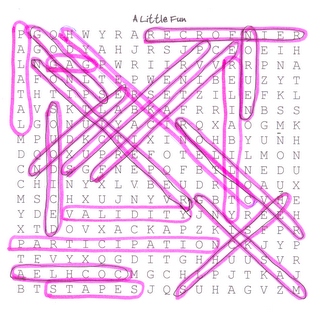
October Word Search Key

Did you solve the word search from the October Newsletter? Did you find all the words? We found an extra one!

click image to enlarge

The words were: cochlea, decidouos, fricative, goals, heschls, hyperkinetic, masking, neuron, nodule, palatal, participation, presbycusis, reinforcer, reliability, repetition, rollover, stapes, validity. And the extra word was “gag.”

We hope you enjoyed this little break from studying!

NSSLHA thanks Suzzane and Sandy for the solution.

Wednesday, November 08, 2006

Want Ad: NSSLHA Officers for 2007!

It’s time for NSSLHA elections!

During the week of November 27 through December 1, NSSLHA is holding elections for the 2007 cabinet. Please be sure to vote! Candidates will be featured on the website as well as the COMD bulletin board.

Application forms are available in the Clinician Prep Room or in MS Word or PDF from the side-bar menu. If you are interested and meet the eligibility requirements, please complete an application form give it to any NSSLHA officer or drop it off in Locker #23. Application forms must be received by Monday, November 13.

A few incentives for becoming an officer include recognition both on campus and off-campus (i.e., resume!). In addition, special scholarship opportunities arise from time to time that favor NSSLHA officers. For instance, the California Speech-Language-Hearing Association (CSHA) will ask CSULA professors to select a NSSLHA officer for nominations.

The following positions are available:

NSSLHA OFFICER DUTIES

President (Jan – Feb*)

  • Graduate student
  • *Carries over to new cabinet year to assist in planning of various functions
  • Schedules cabinet and monthly meetings (e.g., reserves room, coordinates snacks)
  • Greets and makes announcements at meetings
  • Coordinates all club functions (e.g., fundraisers, first year “meet and greet,” mentor/mentee program)
  • Schedules guest speakers
  • Delegates/oversees all other responsibilities
  • Carries over to new cabinet year to assist in planning various functions
  • Various other duties (e.g., assist Dr. Manasse with NSSLHA-related tasks)

Vice President (Jan – Dec)

  • Graduate student
  • Interfaces with COMD department faculty
  • Plans assistance for department functions
  • Interfaces with ASI
  • Oversees monthly calendar of events
  • Organizes refreshments for NSSLHA events

Treasurer (Jan – Dec)

  • Graduate student
  • Accepts/records quarterly dues
  • Restocks and maintains Student Store merchandise (helps if one cabinet member has a Costco card)
  • Collects and records proceeds from Student Store
  • Balances checking account
  • Organizes reimbursement
  • Makes deposit at bank

Secretary (Jan – Dec)

  • Graduate student
  • Maintains chapter membership roster (and records quarterly dues)
  • Sends meeting and event notices via E-mail
  • Interfaces with national NSSLHA
  • Record meeting minutes and publish on website
  • Publish announcements, meeting minutes, events, etc. on NSSLHA website
  • Oversees department bulletin boards

Newsletter Editor (Jan – Feb*

  • Graduate student
  • *Carries over to the new cabinet year to assist with development, layout, editing, etc.
  • Gathers content (e.g., information about the department, field, etc.), enters type, edits copy
  • Prints newsletter at least once a quarter
  • Creates forms, applications, bulletins, and flyers
  • Assists Secretary with website

Undergraduate Representative (Jan – Dec)

  • Undergraduate student
  • The voice for bachelor’s students in both Speech-Language Pathology and Audiology
  • Gather undergraduate/post-baccalaureate E-mail addresses to assist Secretary
  • Make meeting announcements in undergraduate classes
  • Assist all other positions as requested (e.g., suggesting speakers)

ø¤º°`°º¤ø,¸¸,ø¤º°`°º¤ø,¸¸,ø¤º°°º¤ø,¸¸,ø¤º°`°º¤ø,¸¸,ø¤º°`°º¤ø

Thanks to NSSLHA members, the Robert L. Douglass clinic now has a First Aid kit! Funds collected from members are allocated in many ways such as purchasing “Thank You” gifts for our guest presenters, donating to national advocacy organizations, and purchasing items for the clinic.

Tuesday, November 07, 2006

NSSLHA Elections

Are you interested in being a leader in the Communication Disorder Department? Are you interested in bringing speakers and news to your classmates? Are you interested in making a difference? Are you interested in beefing up your resume?

If you answered yes to one or all of the above, then you should run for a position on the NSSLHA Board at Cal State, LA. There are six positions available (five for graduate and one for undergraduate students) for 2007.

These positions can be as big or as small as your board decides! Get involved! Make a difference! Be a leader!

Download the application form and submit it by Monday, November 13th at 6pm. (Available under Local Forms in the right sidebar)

Questions? Ask one of your current officers (links to the right) or leave us a comment!

And don’t forget to vote in the state and local elections today, November 7th!