Hello!
Please note that rather than meeting on the first Monday of the month (as usual), we are holding a special End-of-the-Spring-Quarter meeting!
Stay tuned for more news on what specialties we will feature at the next meeting, on May 22, 2006!
Good luck with midterms and congrats to the future first-year graduate students on their decisions for this Fall!
Wednesday, April 26, 2006

Sunday, April 09, 2006
Team NSSLHA @ the MS Walk
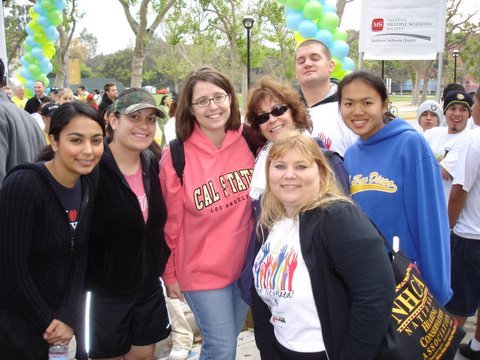 After months of preparation, fundraising, and anticipation, Team NSSLHA at Cal State LA represented at the National Multiple Sclerosis Walk! This fantastic team raised $2,222.00!
Although the MS Walk was set to begin at 9 AM, walkers actually officially began at 8:45 AM. At 8:47 AM, half of Team NSSLHA was already separated from the other half.* Oops! That wasn't because they were racing to the Finish Line to be first in line for Louise's Trattoria...that was because the walk was supposed to start at 9 and some of us really wanted our free chocolate protein bar, bottled water, and fruit!
*The unlost half is represented in this picture. The gentleman in back is NSSLHA Vice-President's significant other, not a random picture-crasher.
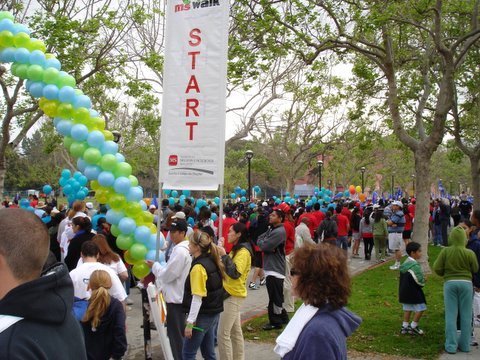 See NSSLHA Treasurer in the blue? She is looking out for her lost team members. What a sport! She helped reunite the team. Phew!
 Hundreds of volunteers and corporate sponsors supported the thousands of walkers. With so many people walking, there was no way we could have sprinted if we wanted to! Instead, we leisurely strolled past the LA Memorial Coliseum, tyco drummers, Exposition Park, many babies in strollers, the Natural History Museum, groups of volunteers with cookies, water, and fruit, and the California Science Center. Team NSSLHA is proud to say that even though we strolled around and through USC, we did not cut corners! We walked every bit of the 5K route. :)
 Some of us (i.e., our awesome Team NSSLHA Co-Captain who doubles as our NSSLHA Newsletter editor)* were so excited to see the Finish Line (not because it was such a long walk, but because we felt a great sense of accomplishment) that we started taking pictures when we saw the Finish Line. The other Co-Captain commented, "Um, shouldn't we actually cross the Finish Line?"
*She was not the only one. She just happened to be singled out because we love her so much. :)
 So we did and kiddo volunteers awarded each walker with medals! We are truly winners!*
*Sans NSSLHA President and a loyal NSSLHA member, this is a picture of the lost-for-a-few minutes half.
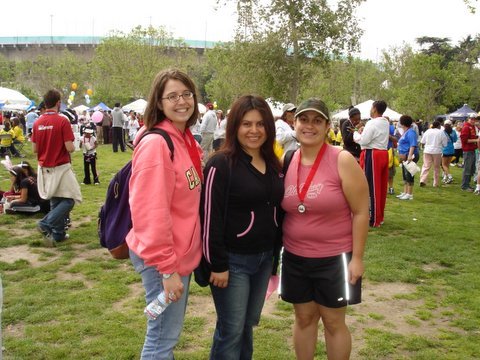 What a success Team NSSLHA was!
Next year, we hope you will join us when we are even more prepared with matching bunny ears or shirts, balloons, NSSLHA signs along the route, and an airplane banner message to cheer us on.
Okay, we're slightly kidding about the latter, but definitely serious about the former.
Thanks again to all participants and donors for truly helping the National Multiple Sclerosis Society fight and find a cure.
Tuesday, April 04, 2006
NSSLHA presents Marilyn Van Dyke, SLP & Mother of Child with Asperger's
In honor of April being Autism Awareness Month, NSSLHA invited Marilyn Van Dyke to speak at yesterday’s meeting. Van Dyke is a speech-language pathologist, CSULA Special Education professor, and mother of a 15 year-old teenager with Asperger’s Syndrome. As if that weren’t enough to keep her busy, she is also currently pursuing her Doctorate’s Degree in Special Education through a joint UCLA and CSULA program.
ø¤º°`°º¤ø,¸¸,ø¤º°`°º¤ø,¸¸,ø¤º°°º¤ø,¸¸,ø¤º°`°º¤ø
Both autism and Asperger’s are classified under Pervasive Developmental Disorder (PDD). Oftentimes, Asperger’s is considered a mild form of autism or Autistic Spectrum Disorder (ASD). A key characteristic of Asperger’s is that the individual generally communicates different to the accepted norm. People with Asperger’s generally lack understanding of social customs and will “freely speak their mind.”
For the Van Dykes, parenting a child with Asperger’s was almost like reliving their youth. Both parents began informal treatment early on with getting their son extremely involved with peers on a regular basis. They knew that peer interaction was key to helping him improve his social skills (pragmatics!). When their son was younger, the Van Dykes would fearlessly bring him to regular outings and birthday parties to engage him in any activity that would facilitate social interactions and friendships. As kid Son grew older, Mom and Dad got “hip” with the times and learned (and played) Pokemon cards and video games with their Son to help him “fit in with the crowd.” As kid Son matured into a young teenager, Mom and Dad found themselves learning about text messaging and even going to rap concerts for their Son’s sake. Pursuing these interests gave their Son a way to engage in successful social interactions with peers.
ø¤º°`°º¤ø,¸¸,ø¤º°`°º¤ø,¸¸,ø¤º°
Future Dr. Van Dyke also gave a brief breakdown of autism. According to the Diagnostic and Statistical Manual of Mental Disorders - Fourth Edition (DSM-IV), the three diagnostic criteria for autism are:
- Impairments in social interactions. In particular, eye-gaze, reciprocity, and joint attention are key characteristics to note. At as early as a few months old, researchers have noted how “different” babies with autism interact. “Even as a baby, holding and feeding is not the same at as young as 6 months,” commented Van Dyke. “It is the impairment in this particular area that distinguishes [autism] from other disorders.”
- Impairments in communication. “This is the true back and forth, or pragmatics. It is the social use of language.” Van Dyke noted that those who are high-functioning will still have impairments in communication, such as understanding emotions.
- Restricted or repetitive range of interests. People with autism can have an extremely narrow range of interests. For Van Dyke’s son, numbers were his main interest. Anything with numbers would captivate him (e.g., basketball scores).
We thank Marilyn Van Dyke for sharing her expertise as well as personal experience with regards to autism.
Friday, March 31, 2006
More free coffee! @ Peet's

Tuesday, March 28, 2006
Next NSSLHA meeting on April 3, 2006 in KH B-111 @ 6:15 P.M.
Welcome back from Spring Break! We hope you all had a wonderful time off!
As we spring into the new quarter, we hope you will join us for our next NSSLHA meeting!
In honor of April being National Autism Awareness Month, we have arranged a special guest speaker for you! Graduating from CSU Fullerton, Ms. Marilyn Van Dyke is an SLP in a school district, and she is currently pursuing her Ph.D. in Special Education through a joint doctoral program between CSULA and UCLA (Hooray! A Ph.D. candidate! ASHA must be thrilled! Double hooray! A CSULA "student" just like us! :). Future Dr. Van Dyke is also the mother of a child with autism. Come hear her speak about her firsthand experience both as a clinician and as the special mother of a special child with autism.
The next NSSLHA meeting is on Monday, April 3, from 6:15 to 7:00 P.M. in King Hall B-111. As always, X-hour snacks will be served.
See you there!
P.S. We will be selling the remaining SLP clipboards! First come, first served!
As we spring into the new quarter, we hope you will join us for our next NSSLHA meeting!
In honor of April being National Autism Awareness Month, we have arranged a special guest speaker for you! Graduating from CSU Fullerton, Ms. Marilyn Van Dyke is an SLP in a school district, and she is currently pursuing her Ph.D. in Special Education through a joint doctoral program between CSULA and UCLA (Hooray! A Ph.D. candidate! ASHA must be thrilled! Double hooray! A CSULA "student" just like us! :). Future Dr. Van Dyke is also the mother of a child with autism. Come hear her speak about her firsthand experience both as a clinician and as the special mother of a special child with autism.
The next NSSLHA meeting is on Monday, April 3, from 6:15 to 7:00 P.M. in King Hall B-111. As always, X-hour snacks will be served.
See you there!
P.S. We will be selling the remaining SLP clipboards! First come, first served!
Wednesday, March 22, 2006
Juan Last Chantz
One last chance to purchase the speech and language (dysphagia) clipboard! If you haven't purchased yours yet, reserve your copy for $17 by March 28!
Please contact either Kristin, your fabulous Newsletter Editor, or Cheryl, NSSLHA Secretary, at the e-mail links on the side bar.
For more information, please visit February 28th's posting here.
Please contact either Kristin, your fabulous Newsletter Editor, or Cheryl, NSSLHA Secretary, at the e-mail links on the side bar.
For more information, please visit February 28th's posting here.
Monday, March 20, 2006
Textbook sellbacks
Scholarships
Just a reminder that now may be the perfect time to apply for scholarships! (Simply because it's
Spring break. and we actually have some time. Sort of.).
A number of scholarships are available through ASHA. Please visit their website or click here.
CSULA also offers a number of scholarships. For more information, visit here.
Spring break. and we actually have some time. Sort of.).
A number of scholarships are available through ASHA. Please visit their website or click here.
CSULA also offers a number of scholarships. For more information, visit here.
Thursday, March 16, 2006
Super Duper Inc. sale!
St. Patrick's Day Special!
Save 25% on your web order of Super Duper Phonological Awareness products today and Friday only, March 16-17, 2006.
Just select the products that you wish to purchase!
Save 25% on your web order of Super Duper Phonological Awareness products today and Friday only, March 16-17, 2006.
Just select the products that you wish to purchase!
Wednesday, March 15, 2006
ASHA's Award Programs for Students and New Faculty
From ASHA:
To foster leadership and promote careers in academia and research, the American Speech-Language-Hearing Association (ASHA) has created several award programs(http://www.asha.org
The Minority Student Leadership Program is open to racial/ethnic minority students at the levels listed above, who wish to enhance their leadership skills, interact with leaders in the professions, and learn how their association works. Now in its 8th year, this program has given over 200 students' insight into their leadership abilities and a better understanding of how leaders affect change in their professional association and has empowered these students to take risks and meet their own challenges.
The Students Preparing for Academic & Research Careers — SPARC Award, the Advancing Academic-Research Careers — AARC Award, the Student Research Travel Award, and the Minority Student Travel Award were all instituted to increase and retain CSD scientists and faculty. The SPARC and AARC Awards were developed as part of ASHA's Focused Initiative on the PhD Shortage in Higher Education. SPARC's primary focuses are to promote PhD career development for CSD undergraduate and graduate students and to increase the number of PhD teacher–scholars and students who choose higher education as a career option. The AARC Award addresses the shortage of PhD-level faculty by encouraging those at the beginning of their academic research careers to remain in higher education.
ASHA developed the Student Research Travel Award to encourage budding scientists to pursue careers in science and research. This award is available to undergraduate, master's and doctoral students who are the first authors on a technical paper. The Minority Student Travel Award is open to underrepresented racial/ethnic minority students interested in pursuing research. These new scientists will attend the 16th Annual Research Symposium, "Issues of Development and Plasticity of the Auditory System," at the 2006 ASHA Convention in Miami, FL.
Visit 2006 ASHA Award Programs(http://www.asha.org
First Ever Starbucks Break!

If you're a Starbucks aficionado and need a quick "pick-me-up" (not the late night "pick-me-up" -- that's for after finals) for that 1:30, 4:30, or 7:30 PM final, Starbucks is serving up a complimentary "tall" cup of coffee!
Today only, from 10AM to 12 PM, visit any Starbucks and they (should) be serving a 12 oz. cup of freshly brewed "Coffee of the Day."
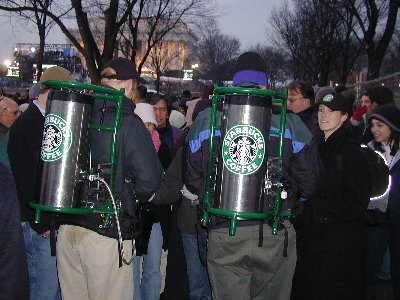
For more info, please visit this online news clip.
If we're lucky, maybe they'll come to us. ;)
**Trivia: Did you know that their mild coffees have more caffeine than their regular, full-body coffee? Cheers!
Monday, March 13, 2006
Kicking off MS Awareness week
It's MS Awareness Week!
We'll keep this short and sweet since we all have final exams looming. :)
Please visit today's special webcast by going here. Today's special webcast features Dr. Peter Calabresi of Johns Hopkins School of Medicine, presenting on "Repairing MS Damage and Protecting the Nervous System."
Happy studying!
We'll keep this short and sweet since we all have final exams looming. :)
Please visit today's special webcast by going here. Today's special webcast features Dr. Peter Calabresi of Johns Hopkins School of Medicine, presenting on "Repairing MS Damage and Protecting the Nervous System."
Happy studying!
Friday, March 10, 2006
Final Exam Schedule
At least for the "evening" classes ;)
In case you need to check for final exam times for other classes, please visit Cal State LA's website (click here).
Don't forget that you can pick up a free scantron and blue book from ASI (just bring your current student ID card). Good luck everyone!
| Class hours & Days | Final Exam Day | Date | Time |
| Monday only classes | |||
| starting between 4:20 and 6:00 p.m. | Wednesday | Mar 15 | 4:30 - 7:00 p.m. |
| starting between 6:00 and 7:50 p.m. | Wednesday | Mar 15 | 7:30 - 10:00 p.m. |
| starting at 8:00 p.m. or later | Saturday | Mar 18 | 7:30 - 10:00 p.m. |
| Monday/Wednesday classes | |||
| starting between 4:20 and 6:00 p.m. | Wednesday | Mar 15 | 4:30 - 7:00 p.m. |
| starting between 6:00 and 7:50 p.m. | Wednesday | Mar 15 | 7:30 - 10:00 p.m. |
| starting at 8:00 p.m. or later | Saturday | Mar 18 | 7:30 - 10:00 p.m. |
| Tuesday only classes | |||
| starting between 4:20 and 6:00 p.m. | Tuesday | Mar 14 | 4:30 - 7:00 p.m. |
| starting between 6:00 and 7:50 p.m. | Tuesday | Mar 14 | 7:30 - 10:00 p.m. |
| starting at 8:00 p.m. or later | Saturday | Mar 18 | 4:30 - 7:00 p.m. |
| Tuesday/Thursday classes | |||
| starting between 4:20 and 6:00 p.m. | Tuesday | Mar 14 | 4:30 - 7:00 p.m. |
| starting between 6:00 and 7:50 p.m. | Tuesday | Mar 14 | 7:30 - 10:00 p.m. |
| starting at 8:00 p.m. or later | Saturday | Mar 18 | 4:30 - 7:00 p.m. |
| Wednesday only classes | |||
| starting between 4:20 and 6:00 p.m. | Friday | Mar 17 | 4:30 - 7:00 p.m. |
| starting between 6:00 and 7:50 p.m. | Friday | Mar 17 | 7:30 - 10:00 p.m. |
| starting at 8:00 p.m. or later | Saturday | Mar 18 | 10:45 - 1:15 p.m. |
| Thursday only classes | |||
| starting between 4:20 and 6:00 p.m. | Thursday | Mar 16 | 4:30 - 7:00 p.m. |
| starting between 6:00 and 7:50 p.m. | Thursday | Mar 16 | 7:30 - 10:00 p.m. |
| starting at 8:00 p.m. or later | Saturday | Mar 18 | 1:30 - 4:00 p.m. |
In case you need to check for final exam times for other classes, please visit Cal State LA's website (click here).
Don't forget that you can pick up a free scantron and blue book from ASI (just bring your current student ID card). Good luck everyone!
Monday, March 06, 2006
NSSLHA presents the National Multiple Sclerosis Society
Congratulations to pre-graduate student winner Ms. Anna Lim! She was the lucky raffle winner of the fabulous SLP-oriented clipboard!
ø¤º°`°º¤ø,¸¸,ø¤º°`°º¤ø,¸¸,ø¤º°
Tonight, NSSLHA welcomed two representatives from the Southern California Chapter of the National Multiple Sclerosis Society (NMSS). Ms. Julia Hakim is the Programs Mangers of Knowledge/Family Programs and Ms. Mercy
Multiple sclerosis is a degenerative disease of the brain and spinal cord (collectively called the “central nervous system” or “CNS,” according to Dr. Nancy Manasse, NSSLHA @ CSULA’s advisor). In particular, MS causes gradual destruction of the myelin that surrounds neurons located throughout the CNS. In many individuals, the demyelinization causes various symptoms depending upon which neural signals are interrupted. The symptoms that individuals experience vary from one person to another. Symptoms may be mild, such as numbness or tingling sensations in the limbs. Severe symptoms include paralysis, loss of vision, and/or cognitive decline. Many individuals with MS also experience difficulties with speech production, which is where SLPs come into the picture!
As Ms. Hakim disclosed, “MS is not as rare as many people think.” The *prevalence rate,* or the number of individuals affected at a given time, is an estimated 400,000 people across the
Unfortunately, the cause of MS is unknown, and the progress, severity, and symptoms of MS in any individual cannot be predicted. Although treatments are available, they serve only to slow down the progression of the disease. They do not cure or reverse the disease. The difficulty in finding a cure also rests on the fact that finding a cure has a different meaning for different people, since no two individuals experience the same symptomatology and severity.
Until there is a cure, NMSS will continue to advocate for individuals with MS.
“The mission of the National Multiple Sclerosis Society is to end the devastating effects of MS.”
NMSS is the “largest private sponsor of MS research in the world.” Out of every dollar that is donated, 48 cents goes to local programs and services for people with MS and their families, 31 cents goes to research and national programs, and 15 cents goes to fundraising.
We hope you will join us today in fighting MS, “one person at a time,” by participating in the MS Walk on April 9th at Griffith Park, or by donating as little as a $1 to the cause.
Lastly, to learn from an educational standpoint on how SLPs are directly involved with individuals with multiple sclerosis, take COMD 555 (Motor Speech Disorders)!
Sunday, March 05, 2006
Hoop dreams of a teen with autism
Hope you enjoy this track from Google videos:
When the high school basketball team manager with autism "got his chance in the spotlight, he shattered everyone's expectations by scoring 20 points in four minutes."
Click here to watch the hoop dreams of a teen with autism.
:*)
P.S. Re: "people first" language ~ as future professionals, we need to be sensitive about putting individuals before their disability. According to commentator Kathy Snow of the Disability is Natural website, people first language describes what a person has, not who a person is. "It's all about respect and dignity, not political correctness."
P.P.S. The "P.S." was added in because Google referred to the teenager as "the autistic teen." =O
Happy 10th week,
Your NSSLHA Secretary with a minor case of insomnia/"2nd wind"
When the high school basketball team manager with autism "got his chance in the spotlight, he shattered everyone's expectations by scoring 20 points in four minutes."
Click here to watch the hoop dreams of a teen with autism.
:*)
P.S. Re: "people first" language ~ as future professionals, we need to be sensitive about putting individuals before their disability. According to commentator Kathy Snow of the Disability is Natural website, people first language describes what a person has, not who a person is. "It's all about respect and dignity, not political correctness."
P.P.S. The "P.S." was added in because Google referred to the teenager as "the autistic teen." =O
Happy 10th week,
Your NSSLHA Secretary with a minor case of insomnia/"2nd wind"
Saturday, March 04, 2006
MS Awareness Week March 13-17
 You may have noticed that several NSSLHA members are actively involved in raising awareness of multiple sclerosis. As previously mentioned (again & again ;), several of us are participating in the National MS Walk on April 9th, and we are also hosting a representative from the National MS Society at our next NSSLHA meeting on Monday, March 6!
We hope that as future communication disorders professionals, you will join us in learning more about MS and raising awareness during the week of March 13 through 17. We are not psychics (most of the time), so we cannot predict whether you will help individuals with MS in your near future, but we can assure you that the more knowledge you have of all the disorders and diseases that our future clientele may have, the better off you -- and society -- will be. :)
More information will follow.
Thursday, March 02, 2006
Do you have Financial Aid?
Newsflash!
The phone number for the Center for Student Financial Aid has been changed to (323) 343-6260.
The phone number for the Center for Student Financial Aid has been changed to (323) 343-6260.
ø¤º°`°º¤ø,¸¸,ø¤º°`°º¤ø,¸¸,ø¤º°°º¤ø,¸¸,ø¤º°`°º¤ø,¸¸,ø¤º°`°º¤ø
In addition, the 2006-07 Scholarship application and CSU System-Wide Scholarship Application are now available @ http://www.calstatela.edu/univ/finaid/forms.htm.
DEADLINES – Many of the 2006-2007 Cal State L.A. scholarships are awarded for the 2006 fall quarter only. Larger awards are divided by quarters and will be processed for fall, winter, and spring disbursements.
- March 10, 2006: Deadline for new students (high school seniors, transfers, and graduates) to apply. All application materials must be in the Center for Student Financial Aid by 4:00 p.m., Friday, March 10, 2006.
- April 14, 2006: Deadline for continuing CSULA students to apply. (Continuing students are defined as those who have established a three-quarter CSULA GPA at the time of their application). All application materials must be in the Center for Student Financial Aid by 4:00 p.m. on Friday, April 14, 2006.
Please visit the CSULA Financial Aid website for more information.
ø¤º°`°º¤ø,¸¸,ø¤º°`°º¤ø,¸¸,ø¤º°
- Submit 2005-2006 FAFSA on the Web Applications by midnight Central Daylight time, June 30, 2006.
- Submit 2006-2007 FAFSA on the Web Applications by midnight Central Daylight time, July 2, 2007.
Wednesday, March 01, 2006
Next NSSLHA meeting on March 6, 2006 in KH B-111 @ 6:20 P.M.
Remember the young & restless days of elementary school? Recesses, handball, and pizza parties for being the top-notch class...Wow, time flies!
Gear up for finals and a flashback to the good ol' days by taking a small pizza party break with NSSLHA!
 On Monday, March 6, NSSLHA will throw a quick 10-minute pizza party -- in addition to the regular X-hour snack variety -- because we want to (positively reinforce you, negatively reinforce the NSSLHA officers, and) thank you for your loyal support and for being the "top-notch class"!
More importantly, we are bringing yet another fabulous guest speaker! Please join us as we welcome representatives from the National Multiple Sclerosis Society!
As you may know, some CSULA students will participate in the National Multiple Sclerosis Society Walk on April 9th. (For more information, please contact our fabulous NSSLHA Newsletter Editor/multi-media woman/creative art director/team co-captain, Kristin Reisch, or our NSSLHA Secretary/crazy E-mailer/other co-captain, Cheryl Liang).
(¯`'•.¸(¯`'•.¸(¯`'•.¸But wait! There's more!¸.•'´¯)¸.•'´¯)¸.•'´¯)
Not only are we throwing a pizza party and hosting a guest speaker, we have one more incentive!
One lucky raffle winner will receive an envy-*evoking* SLP/Dysphagia clipboard (see yesterday's post) -- worth $20! Envious or not, non-winners can still purchase the clipboard for the 15% discounted price of $17.
See you there!
Gear up for finals and a flashback to the good ol' days by taking a small pizza party break with NSSLHA!
 On Monday, March 6, NSSLHA will throw a quick 10-minute pizza party -- in addition to the regular X-hour snack variety -- because we want to (positively reinforce you, negatively reinforce the NSSLHA officers, and) thank you for your loyal support and for being the "top-notch class"!
More importantly, we are bringing yet another fabulous guest speaker! Please join us as we welcome representatives from the National Multiple Sclerosis Society!
As you may know, some CSULA students will participate in the National Multiple Sclerosis Society Walk on April 9th. (For more information, please contact our fabulous NSSLHA Newsletter Editor/multi-media woman/creative art director/team co-captain, Kristin Reisch, or our NSSLHA Secretary/crazy E-mailer/other co-captain, Cheryl Liang).
(¯`'•.¸(¯`'•.¸(¯`'•.¸But wait! There's more!¸.•'´¯)¸.•'´¯)¸.•'´¯)
Not only are we throwing a pizza party and hosting a guest speaker, we have one more incentive!
One lucky raffle winner will receive an envy-*evoking* SLP/Dysphagia clipboard (see yesterday's post) -- worth $20! Envious or not, non-winners can still purchase the clipboard for the 15% discounted price of $17.
See you there!
Tuesday, February 28, 2006
You think you may not need it...but you will ;)
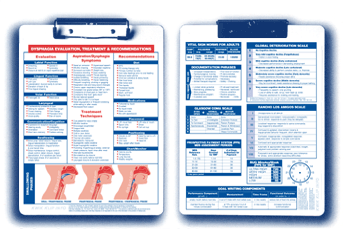 Clipboards for sale! But these aren't just any clipboards...these are specially made for SLPs!
Does NSSLHA listen to your requests? Absolutely!
In response to requests from students in the Dysphagia Class, NSSLHA will be selling the Dysphagia Evaluation: Treatment & Recommendations Clipboard at the next NSSLHA meeting (which is
The clipboards feature the following:
- 24 Hour Clock
- Aspiration/Dysphagia Symptoms and Treatment Techniques
- Documentation Phrases: Do’s and Don’t’s
- Evaluation: labial function, lingual function, velar function, laryngeal, communication/cognition, swallowing
- Glascow Coma Scale
- Global Deterioration Scale
- Goal Writing Components
- Prospective Payment System (PPS) MDS Assessment Periods
- Rancho Los Amigos
- Recommendations for: diet, meds, placement, positioning, chart/monitor
- RUG Minutes/Week (PPS for SNF)
- Swallowing Phases in pictures
- Vital Sign Norms for Adults
Each clipboard comes with a laminated pediatric information chart, International Phonetic Alphabet (IPA) chart, word retrieval cues, developmental milestones (think of COMD 456, 460, and 551), phonological processes (think of Dr. Flint’s “rules,” COMD 471, and 553), type-token-ratio (TTR) and mean length utterance (MLU) formulas, and vocal fundamental frequency in boys and girls (think of Audiology courses).
Not only that, but they are very *functional* and will help make those days in the hospital (i.e., 2nd year graduate school externships) a bit easier because you will always have a “cheat sheet” with you! Whether you are an undergraduate or graduate student, you can buy one now to prepare for your hospital externship! And that’s not all – you can use it all throughout your career!!
The Annual ASHA Convention didn’t even offer this! Don’t miss out on this opportunity!
For more information, please visit this website.
Monday, February 27, 2006
*Bonus* meeting - presenting Dr. Arlene Pietranton, ASHA Executive Director
A very special thanks to Dr. Pietranton, Executive Director of ASHA, for taking time out of her very busy schedule to speak to NSSLHA at CSULA!
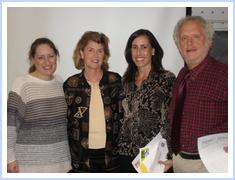
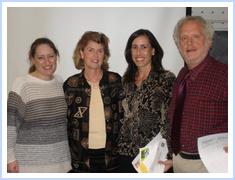 Tonight, Dr. Pietranton gave a special inside perspective on ASHA's internal network, in addition to how we as (future) members of ASHA can benefit from all the resources that are available to us. As Dr. Pietranton best described, "[ASHA] is our professional association; it belongs to us who are members. It advocates for us, engages in public relations and regulations for us...It is the organization through which we, as members, decide what are the best practices for our profession."
.·:*¨¨*:·. .·:*¨¨*:·..·:*¨¨*:·. .·:*¨¨*:·. .·:*¨¨*:·. .·:*¨¨*:·. .·:*¨¨*:·.
What is ASHA?
"A national professional, scientific, and credentialing organization."
Although many know that ASHA is the nation’s largest speech, language, and hearing association and that we should all “be” members, there is more to this organization than meets the eye. This association sets the standards and paves the way for our profession…and our future. It decides what knowledge and skills we should have to be considered a qualified and competent professional.
ASHA Facts and Resources
- ASHA currently represents 123,190 speech-language pathologists, audiologists, and speech, language, and hearing scientists. As of
- There is a shortage of males in both speech-language pathology and audiology. "ASHA's goal is to mirror the crowd that we deliver services to," commented Dr. Pietranton, "but we have a long way to go." According to ASHA, “Males currently comprise 4.4% of speech-language pathologists, 18.6% of audiologists, and 28.4% of those with dual certification. Overall, the proportion of male ASHA constituents has declined steadily."
Important Resources
- American Speech-Language-Hearing Foundation (ASHF). Go to ASHF's website for ongoing scholarships and grants. Are you interested in pursuing a doctoral degree or need new investigator grants for research? ASHF may be able to aid you!
- As a paying member, you can go to ASHA's website for online archives of their scholarly, peer-reviewed journals that date back to 1990. (This has come in VERY handy throughout many of our undergraduate, post-baccalaureate, and graduate studies.)
- As Ms. Lisa Aniversario mentioned in our February meeting, the Minority Student Leadership Program (MSLP) is a "leadership development program established for racial/ethnic undergraduate senior and graduate students who are enrolled in communication sciences and disorders programs." Applications are available in March.
- ASHA gathering place: Join ASHA's mentor/mentee program. You can be paired up with a professional who will give us insight through our academic studies and help us launch our careers!
- Get involved! "Get involved on a local, state, or national level. If you are interested in shaping the future of our profession, volunteering is a great way to benefit, learn from, and shape our field.” Dr. Pietranton suggests that to familiarize yourself with the committees and boards. "Let someone know that you are interested; fill out a Pool Form and submit it!" (Pool Forms are available online at www.asha.org)
Questions & Answer
Q1: On the critical issues listed in your Powerpoint, you note that caseloads in schools are huge. What is ASHA doing? (Note: Dr. Pietranton's Powerpoint presentation is available on the sidebar menu, under "Local Forms")
A1: “ASHA is doing a number of things. We are putting into place the opportunity for more involved partnership between ASHA, as a national association, and targeted state associations because some of the regulations are decided at the state and federal level. In the last eight years, we have been trying to influence at the federal level, so we commit to work with targeted states to try to influence the public policy and educational regulations...We are working on promoting a "workload model," which focuses on workload rather than caseload. It's not about the numbers, it’s about what the kids need, how many meetings we go to, how much paperwork we have. It’s more of a refined way of looking at what is the amount of time and effort that is associated with the workload versus the caseload. Some work with the targeted states have adopted that model so they’ve moved away from the cap of 80 to 100 students. It is important that people in decision-making roles in related fields understand the value of this model so that they can advocate for this."
Q2: Regarding the doctoral shortage, I noticed the majority of the programs are on the East Coast. Is anything being done to bring more doctoral programs closer to us?
A2: Currently, the state universities are not allowed by state law to offer doctoral programs. Many UCs [
Q3: Can ASHA be more involved at a state level? Perhaps work with CSHA [California Speech-Language-Hearing Association]? Could ASHA encourage CAA to look at standards differently? Can public policy be different?
A3: I am not aware of any commitment in a targeted look other than an awareness that there are some unusual circumstances.
Q4: What, besides academic knowledge, should we take away from our education?
A4: One of the most important things is to take away the framework for life-long learning. The evolution of the profession and the opportunities as professionals is very exciting. It creates a range of possibilities that will be with us for our whole career.
Whether we identify with one setting or re-tool and move across settings, is the notion of life-long learning. The other piece of advice is being evidence-based so that our profession has integrity and credibility.
Overview of ASHA's programs
"These are the core aspects of the services and activities that [ASHA] engages in."
- Academic Affairs works closely with instructors, student affairs, counselors, researchers to identify issues, forecast needs and trends, recommend policies, and work to ensure that the needs of academic programs are addressed
- Accreditation looks at the important qualifications a graduate program should have to ensure that the graduate students become certified in this field.
- Action center is the "“triage center" that takes general questions and requests. If you have questions or concerns, you can contact them via E-mail at actioncenter@asha.org or Professionals/Students can call 1-800-498-2071, 301-897-5700 TTY; general public can call 1-800-638-8255. Available
- Audiology Practices "provide consultation on audiology policy and practice to members, federal agencies, media, and other external publics; assist in association policy development; track and recommend Association action to respond to relevant national trends; recommend and plan audiology service and programs and educational product development."”
- Certification sets the standards and requirements for who can practice.
- Communications oversee all the scholarly journals/publications (i.e., ASHA Journal, ASHA Leader). All ASHA publications dated back to 1990 are available online to members.
- Ethics ensures the public that they are receiving safe and competent service from professionals, by regulating what is an appropriate code of conduct.
- Government Relations and Public Policy decides on issues such as how services get reimbursed and where ASHA should invest money. Recently, ASHA is funding awareness in two arenas. 1) Evidence-Based Practice. Professionals need to use research data to drive clinical decision making. 2) Doctoral Shortage. There is a shortage of individuals who have or are pursuing Doctoral Degrees. ASHA is working on this to assure that this field will continue to be a scientific-based field.
- Membership: Join now! ;)
- Product Development and Sales are the liaisons between various vendors such as textbook vendors.
- Office of Multicultural Affairs (OMA) "addresses cultural and linguistic diversity issues related to professionals and persons with communication disorders and differences."
- Professional Education "review and recommend policies and procedures to the Executive Board for the planning, coordination and evaluation of all Association sponsored continuing education activities and products [and] develop and maintain an integrated plan for all continuing education activities and products" so that professionals can continue to develop necessary skills.
- Science and Research actively track data sources such as incidence figures, work force trends, etc. Note: if you are doing a research paper and need any information regarding data sources, you can call the national office and they will help identify some data sources for you!
- 16 Special Interest Divisions that members can belong to, identify with, or learn more from, in a particular area of practice. Professionals can network and focus on an area of expertise on a smaller scale.
.·:*¨¨*:·. .·:*¨¨*:·..·:*¨¨*:·. .·:*¨¨*:·. .·:*¨¨*:·. .·:*¨¨*:·. .·:*¨¨*:·.
In closing, Dr. Pietranton commented, "Do what you want to do and do it well. Find things that you really are passionate about, things that really matter to you because you will do it well and with energy and passion, and your excellence will be noted and other opportunities will follow. Be open to those other opportunities as well"
Fellow colleagues ~ keep learning, get involved, pursue a doctoral degree, and practice evidence-based practice! Most importantly, be passionate about it all!
Subscribe to:
Posts (Atom)